

The growing appetite for high-protein foods and snacks is reshaping and influencing decisions throughout the agricultural supply chain. Social media, in part, has been a driving force behind major food consumption changes and emerging trends, particularly growing popularity of high-protein foods and snacks. As a result, foods like cottage cheese, Greek yogurt, eggs, and protein bars have gained popularity across consumers who are looking to boost protein-intake or try new and trending foods.
Popular high-protein foods are sourced from the U.S. dairy industry. Foods like Greek yogurt, cottage cheese, and whey are all products derived from dairy processing. Interestingly, foods from these dairy processes are very high in protein content as the protein content in milk becomes concentrated or extracted from the whey.
- Cheese is the classic by-product of milk curdling in which solid curds are processed into cheese.
- Whey is the liquid remaining after the milk curdling process used to make cheese. In other words, when cheese production increases so does production of whey.
- Whey Protein Concentrate is the value-added product made from whey through filtering and drying processes that concentrate the proteins. Commonly used in protein shakes, protein bars, and other high protein foods.
- Cottage cheese is produced by milk curdling and separating the curds from whey.
- Greek yogurt is produced by straining fermented milk to remove most of its liquid whey resulting in a thicker yogurt with higher protein content compared to regular yogurt.
The Cargill 2025 Protein Profile indicates that in 2024, 61% of Americans increased their protein intake versus only 48% who did so just five years prior in 20191. While protein can be found in other foods like animal proteins that still remain popular among consumers, dairy products have recently emerged as trendy and healthy alternative options for snacks and convenient high-protein options.
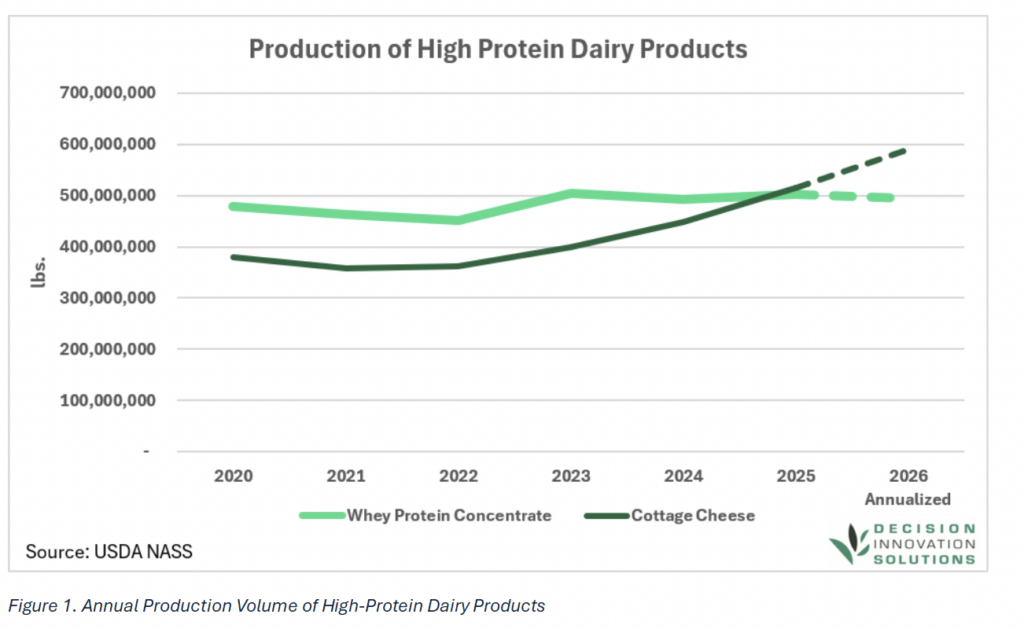
Cottage cheese production from 2020 to 2025 increased nearly 36% whereas cheese production in general increased just 12% in the same period. In the last two years (2023-2025) cottage cheese production increased 29% (Figure 1). The comparison of cheese production to cottage cheese production does not suggest that cottage cheese is replacing cheese; however, it does suggest rapid growth in a niche market relative to other established dairy product markets. While cheese production has experienced somewhat steady growth year-over-year, the growth in cottage cheese production has increased rapidly in the last two to five years, suggesting that viral trends in high-protein diets may be reflected in current production trends as well.
Similarly, domestic consumption of cheese in 2025 totaled 6.23 million MT; in 2026 domestic consumption of cheese is estimated at 6.21 million MT. Production, on the other hand, is expected to rise from 6.7 million MT in 2025 to 6.8 million MT in 2026. Even as domestic consumption of cheese is anticipated to slightly decline in 2026, the rise in production may suggest that the co-products of the curdling process to make cheese (e.g., whey) may expand the availability of products containing whey like whey protein concentrate found in protein shakes and protein bars. The surplus in cheese is expected to drive U.S. cheese exports up 23% from 2025.
While annual Greek yogurt production is often not explicitly reported, recent investments by major U.S. Greek yogurt producers indicate some degree of continued market growth and expansion. Chobani, a well-known Greek yogurt brand, announced a $1.5 billion investment in a New York plant following a $500 million expansion in Idaho. In turn, these facilities require mass amounts of milk, supplied by the U.S. dairy industry, to meet processing efficiency and consumer demand.
In the background of emerging and changing consumption trends among consumers, the U.S. dairy industry as a whole is experiencing some significant growth and changes. Over the past two decades milk cow inventory has fluctuated within a relatively narrow range, reaching a low of 9.05 million head in 2005 and peaking at 9.65 million head in July 2025. Despite these annual fluctuations, annual dairy cow inventory levels have had an increasing trend since 2005. In terms of production, overall productivity per cow has increased dramatically and steadily over the past 20 years. Since 2005, milk production per cow has increased nearly 25%, with an average annual increase of approximately 1% (Figure 2).
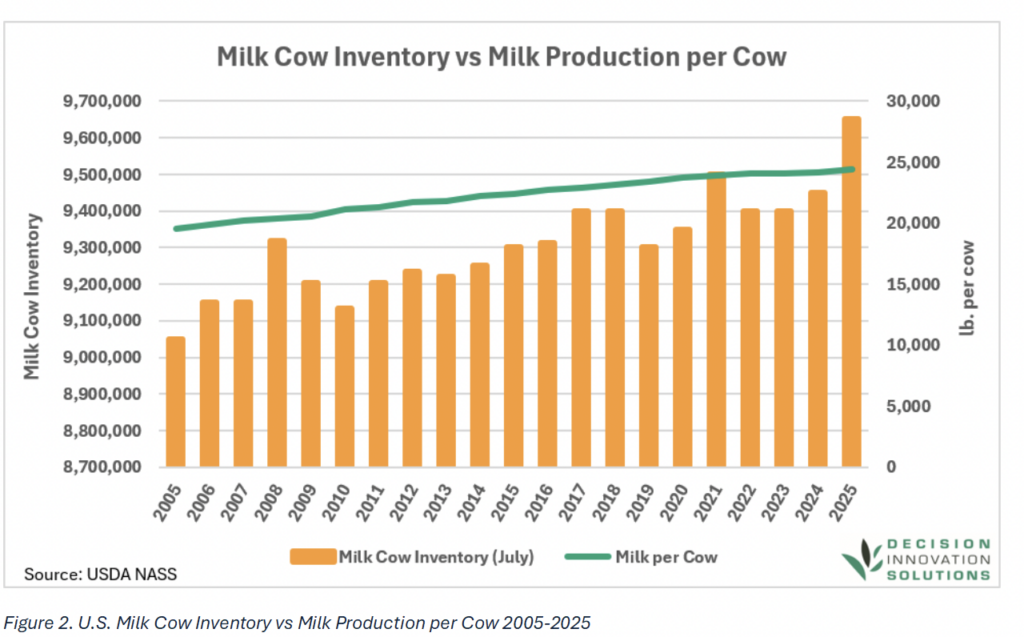
The U.S. dairy industry is a cornerstone of the evolving protein consumer landscape. With many dairy products containing high protein content, the industry is in a unique position to offer high-protein products with a growing demand among consumers. The U.S. dairy industry has experienced steady growth throughout the last two decades in terms of production per cow, and milk cow inventory levels reaching two-decade high levels in 2026 at 9.65 million head, up nearly 200,000 head from a year ago. Changes to consumer preferences, even when driven by social media and societal trends, can have implications throughout the supply chain.