

As we continue our march toward the halfway mark in 2026, I thought an update on the incredible work the DIS Team has been engaged in would be appropriate. As has been the case since 2007, we continue to partner with our clients on a wide range of exciting projects, to the point that with our newest hire (Micheal Nading, Jr.) we have recently expanded our home office footprint by 33%! To put it mildly, we’re making hay while the sun shines!

Strategic Assessment on Impact of Vitamin and Amino Acid Supply Chain Disruptions on U.S. Food Security
Supplemental amino acids and vitamins are essential to optimal growth and production of poultry, swine, beef and dairy in the U.S. Similar to supply chain risks associated with “rare earths”, another critical, albeit lesser known, supply chain at risk is related to critical amino acid and vitamins which are needed for the animal agriculture industry. This research, completed for the Institute for Feed Education and Research (IFEEDER), studied the global supply and demand of four key amino acids (Lysine, Methionine, Threonine and Tryptophan) and four key vitamins (A, B-Complex, D3 and E), their world trade, and their inclusion in livestock and poultry diets. Impacts on Key Performance Indicators (KPIs) from disruptions to the trade of these amino acids and vitamins were assessed. To determine the ability of the animal agriculture industry to adapt to reduced availability of these key diet ingredients, representative industry diets were adjusted to include, to the extent possible, alternative ingredients in attempt to balance rations. Depending on species and vitamin acid/vitamin, success in doing so was mixed.
Nebraska Sustainable Aviation Fuel (SAF) Feasibility and Economic Impact Study
Nebraska has the potential to play a significant role in the national transition toward Sustainable Aviation Fuel (SAF), supported by its ethanol industry, access to carbon capture and sequestration via pipeline (CCSvP), and an extensive agricultural base. This analysis, completed for Renewable Fuels Nebraska, looked at the “Big Picture” regarding what estimated jet fuel and SAF feedstocks would be in 2040, prospects for ethanol without using a portion of it for Ethanol-to-Jet (ETJ), the market potential for ultra-low carbon ethanol, and the potential gains enabled by ultra-low carbon ethanol and ETJ in Nebraska. Farm level benefits were also estimated at the Nebraska level. Additionally, the feasibility of the SAF industry was studied, as was the economic impact of the various future pathways.
Cumulative Effects of E15 Sales to Minnesota
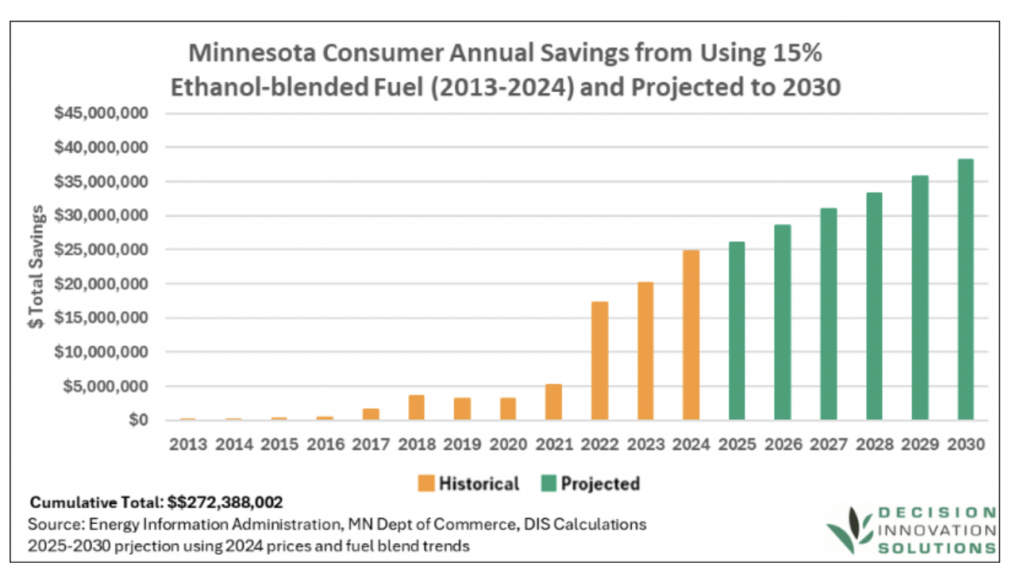
Consumers Minnesota has long been a leader in the sales of higher concentration ethanol blends. This work, completed for the Minnesota Biofuels Association, studied the cumulative effects of the sales of higher ethanol blends and how they relate to sales of other transportation fuels from volume and value standpoints. Consumer savings were estimated, as well as the total economic impact of these savings to the Minnesota economy. Check out the write-up on this exciting research in the Ethanol Producer Magazine
The Economic Impact of the Trailblazer Pipeline Conversion and Extension to Ethanol Plants
Federal policy, particularly that which is contained in Section 45Z, has created large incentives for carbon capture and sequestration. To capture the financial incentives from the tax provisions in 45Z, Trailblazer decided to convert a natural gas pipeline to one that would instead transport CO2. This project estimated the total economic impacts from the conversion of the pipeline, construction of laterals to ethanol plants near its path, and the average annual operation of the entire pipeline. Expert witnessing related to our work was also provided for the regulatory review process.
The Economic Impact of aMPV on the Minnesota Turkey Industry
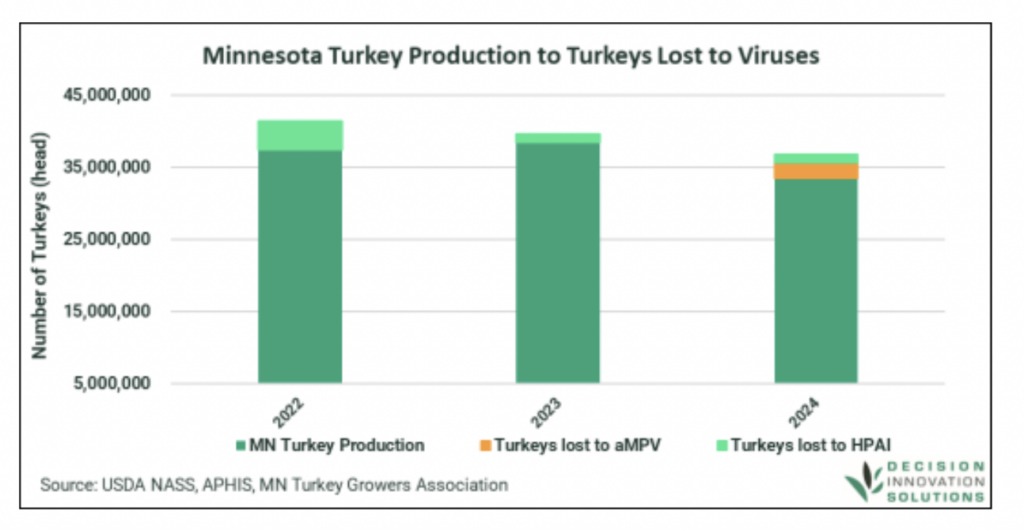
At the time of publication, the U.S. poultry industry was seeing increasing impact by the rapid spread of poultry viruses. Avian Metapneumovirus (aMPV) had emerged as a significant productivity and economic threat to turkey growers in all major turkey producing states (Minnesota ranks as the top state in turkey production by volume). This research studied the total economic impact of aMPV on the turkey industry in Minnesota. Here’s the press release from our client, the Minnesota Turkey Growers Association and here’s a link to the report.
Quantifying Cattle Movement and Determining Infrastructure and Critical Control Points for a 12-State Region to Improve Permitted Movement Planning and Continuity of Business
The purpose of this project is to model the movement of finished cattle to harvesting locations, using the DIS Commodity Flow methodology, to quantify the number of cattle movements within a 12-state region. A database and maps are being used to model the quantity and movement of fed cattle to harvest facilities throughout the 12-state region. Additionally, a matrix is being created that will illustrate a network of intra- and interstate routes that will capture the current infrastructure for the movement of cattle. A comprehensive report will detail the quantity and routes of cattle movements within a 12-state region and include maps, summary tables, charts of flow, and a summary of state-to-state movements. The information that will come from the report can be used by state and federal animal health officials for testing current plans and systems used for foreign animal disease response activities, particularly for the permitting of animal movement, disease traceability, and mitigation strategies that promote disease containment and continuity of business.
The Impact of LCFS Policy on Agriculture and Allied Industries in Minnesota
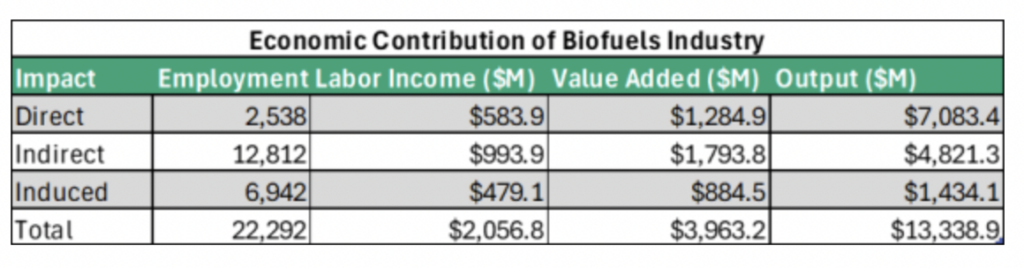
For the last several years, the Minnesota legislature has discussed bills that would pattern a new state level low carbon fuels standard (LCFS) after those existing in other states, the most notable of which being California. This project studied the current economic contribution of the biofuels market in Minnesota (shown in the table below), the economic impact of an LCFS in Minnesota, along with its supply chain and infrastructure impacts on the Minnesota economy, particularly the costs to Minnesota agriculture. Policy implications were also discussed.
How Can Team DIS Help You?
As listed above, our team enjoys a wide variety of projects for our long-time clients, as well as with other first-time clients . These projects often require a diverse set of skills, providing our team with opportunities for continuous learning, stronger relationships and greater achievements. Perhaps the above examples spark a thought or question – if so, we look forward to connecting with you soon!